If you are searching for a neighborhood that offers more than just a house, Queen Creek likely keeps showing up for good reason. Many buyers want a place where trails, parks, pools, and everyday convenience all work together, not a patchwork of disconnected features. In Queen Creek, master-planned living often delivers exactly that, with a range of community styles to fit different priorities. Let’s take a closer look at why so many buyers are drawn to it.
Queen Creek offers room to grow
Queen Creek has grown quickly in recent years, and that growth helps explain why master-planned communities play such a big role in the local housing market. According to the Town of Queen Creek, the population reached an estimated 89,770 residents in 2025, up from 59,519 in 2020.
That kind of growth creates demand for neighborhoods with organized layouts, built-in amenities, and easy access to daily needs. For many buyers, master-planned living feels appealing because it offers a more complete lifestyle from day one, rather than waiting years for the area around them to catch up.
Trails and open space stand out
One of the biggest reasons buyers love Queen Creek is the connection to outdoor space. The town’s trail system includes multi-use paths along the Queen Creek and Sonoqui washes, with the Queen Creek Wash Trail running about six miles and the Sonoqui Wash Trail about 3.8 miles.
These trails connect open space, farmland, residential areas, and nearby recreation, including San Tan Mountain Regional Park. The Town of Queen Creek also notes that the trail system reflects the area’s equestrian and agricultural heritage, which gives many neighborhoods a distinct local feel.
Why this matters to buyers
When trails and greenbelts are built into the community design, it becomes easier to enjoy walking, biking, and time outdoors as part of your normal routine. You are not just buying square footage. You are buying access to the kind of everyday environment many people want but struggle to find.
For buyers comparing East Valley locations, that blend of suburban convenience and open-space connectivity can make Queen Creek especially attractive. It creates a lifestyle that feels more balanced and less crowded, even as the town continues to grow.
Amenities add everyday convenience
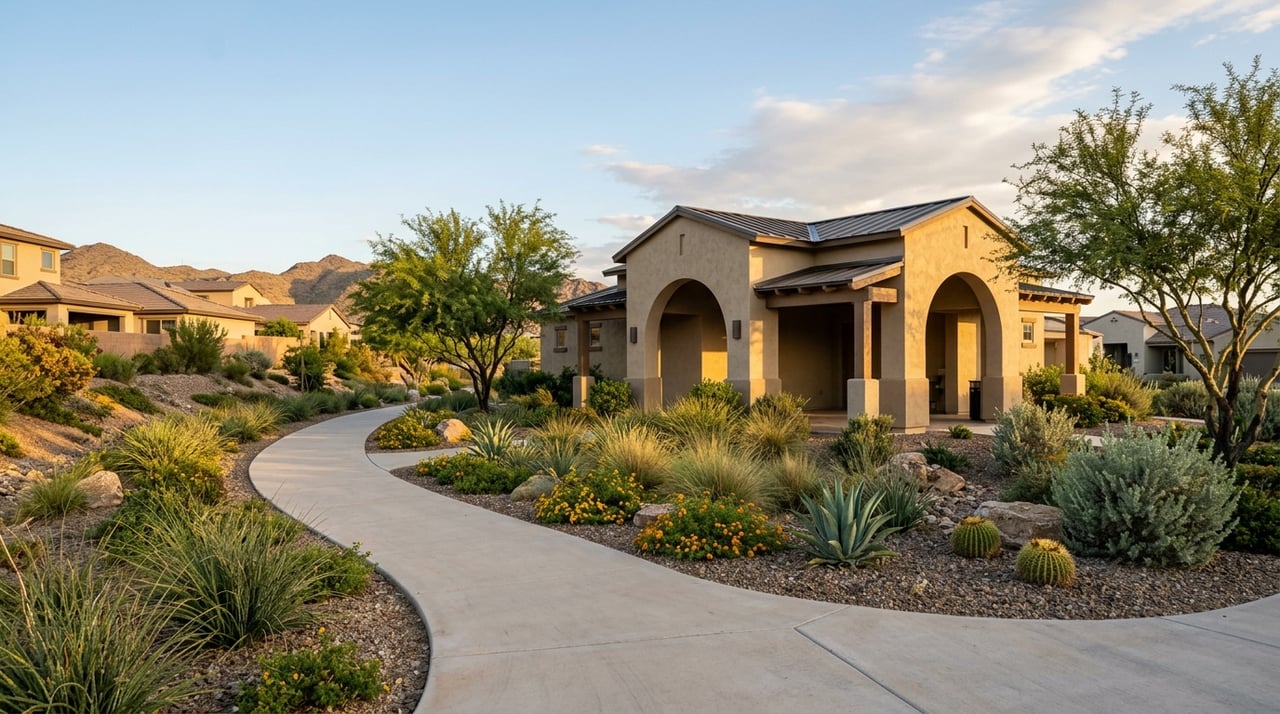
Master-planned living in Queen Creek often means more than attractive streetscapes. Many communities are designed with amenities that support recreation, social gatherings, and day-to-day enjoyment close to home.
Depending on the neighborhood, buyers may find features like:
- Community pools
- Splash pads and aquatic areas
- Clubhouses or event spaces
- Parks and playgrounds
- Pickleball, basketball, or bocce courts
- Lakes, walking paths, and ramadas
- Greenbelts and open space
This variety matters because not every buyer wants the same thing. Some want simple park space and walking trails, while others are looking for a stronger social calendar or resort-style amenities.
Queen Creek communities offer different lifestyles
A key reason buyers respond well to Queen Creek is that master-planned living here is not one-size-fits-all. The local market includes several community types, which gives you more flexibility to choose a neighborhood that matches how you want to live.
Harvest offers an agrarian-inspired setting
Harvest is one example of a community with an amenity-rich, neighborhood-focused design. The Meadows Collection highlights interconnecting trails, a community center, an outdoor pavilion, a lake, and a splash pad, along with 45-foot homesites.
For buyers who want shared amenities and a connected neighborhood layout, this type of setup can feel practical and welcoming. It also shows how Queen Creek communities often blend outdoor features with everyday convenience.
Tierra at Legado West gives more open space
Tierra at Legado West reflects a different kind of buyer preference. The builder highlights 100-foot homesites, more than 20 acres of open space and trail network, parks, play structures, sports lawns, and a covered ramada.
That combination may appeal to buyers who want more room between homes while still enjoying a planned community setting. Its proximity to shopping, dining, and entertainment also supports the appeal of having both space and convenience.
Barney Farms leans into destination-style amenities
Barney Farms stands out for buyers who want a highly designed amenity package. The community is centered on an active 22-acre lake and includes a lake trail, bridges, boardwalk docks, parks, courts, and reservable ramadas.
Its HOA amenities also include The Barn, which is used for resident events and rentals. For some buyers, that stronger neighborhood amenity structure is a major plus because it creates more ways to enjoy the community beyond the home itself.
Encanterra delivers a resort-style option
Encanterra shows yet another side of Queen Creek living. Shea Homes describes it as a resort community with select 55-plus neighborhoods, two resort clubs, restaurants, event spaces, pools, a spa, pickleball, and an 18-hole golf course.
This is a good reminder that buyers should not assume all master-planned communities offer the same experience. Some are designed around broad all-ages living, while others include age-qualified sections or a more club-centered lifestyle.
Shopping and daily errands are close by
Lifestyle is not just about amenities inside the neighborhood. Buyers also care about how easy it is to get groceries, grab dinner, run errands, or catch a movie without a long drive.
Queen Creek has a substantial retail base around Ellsworth Loop, Rittenhouse, Power, Gantzel, and Riggs. The town’s shopping guide lists centers such as Queen Creek Marketplace, QC District, QC Crossing, QC Commons, and Vineyard Towne Center, with retailers and restaurants that cover many everyday needs.
Convenience supports long-term livability
When buyers picture daily life, they are usually thinking beyond the home itself. A neighborhood can look great on paper, but if shopping and services are inconvenient, the lifestyle may not feel as easy in practice.
That is one reason master-planned living in Queen Creek continues to attract attention. Many communities are positioned near retail and dining, which makes it easier to combine neighborhood amenities with practical convenience.
School access matters for many buyers
For buyers with school-aged children, school access can be an important part of the decision-making process. Queen Creek Unified School District states that it serves about 14,000 preschool through twelfth-grade students across roughly 48 square miles.
Several Queen Creek master-planned community pages specifically note attendance within Queen Creek Unified School District. That does not make one neighborhood universally better than another, but it does show how school access often plays a role in the community search.
HOA and membership details are worth reviewing
One of the most important things buyers should understand is that amenities may come with rules, access systems, and different fee structures. Some neighborhood features are resident-only and may require key fob entry, reservations, or separate membership arrangements.
That means the question is not simply, “Does this community have great amenities?” The better question is, “How do I actually use them, and what is included?”
Questions to ask before you buy
As you compare Queen Creek communities, it helps to ask:
- Are amenities included in HOA dues, or is there an extra membership cost?
- Is the neighborhood all-ages, or are any sections age-qualified?
- How large are the homesites?
- How close are the homes to each other?
- How near are grocery stores, parks, and retail centers?
- Does the community have a strong event calendar or a quieter feel?
These questions can help you move beyond the marketing brochure and focus on how the neighborhood will feel once you live there.
The best fit depends on your priorities
The biggest reason buyers love master-planned living in Queen Creek is simple: there is real variety. You can find communities centered on trails and parks, neighborhoods with larger homesites and open space, lake-focused developments, and resort-style settings with a stronger social component.
That variety gives you a better chance of finding a neighborhood that matches your lifestyle instead of settling for a generic idea of what suburban living should look like. The right choice depends on what matters most to you, whether that is outdoor access, amenities, proximity to shopping, homesite size, or the overall pace of the community.
If you are exploring Queen Creek and want help narrowing down which communities truly fit your goals, Snow Realty & Property Management can help you compare options with local, practical guidance.
FAQs
What is master-planned living in Queen Creek?
- Master-planned living in Queen Creek generally means living in a community designed with a coordinated layout, shared amenities, open space, trails, and neighborhood features such as parks, pools, or club spaces.
Why do buyers like master-planned communities in Queen Creek?
- Buyers are often drawn to Queen Creek master-planned communities because they can offer trails, parks, pools, clubhouse amenities, nearby shopping, and a more connected day-to-day lifestyle.
Are all Queen Creek master-planned communities the same?
- No. Queen Creek includes a range of community types, including neighborhoods with larger homesites, lake-centered communities, agrarian-inspired neighborhoods, and resort-style communities with select age-qualified sections.
Do Queen Creek master-planned communities have HOA rules?
- Many do, and some amenities may be resident-only with key fob access, reservation systems, or membership requirements depending on the community.
Are trails a big part of the Queen Creek lifestyle?
- Yes. The Town of Queen Creek highlights multi-use trails along the Queen Creek and Sonoqui washes, which connect open space, residential areas, farmland, and nearby recreation.
What should buyers compare when touring Queen Creek communities?
- Buyers should compare amenity access, HOA structure, homesite size, proximity to shopping and services, age restrictions if any, and whether the community atmosphere feels more social or more low-key.